FAUST · 9 / 10
Chapter IX: Land, Power, and Building Toward the End
Blind, ancient, and still commanding, Faust remakes the earth itself — and in the vast machinery of land reclamation finds at last the terrifying proximity of satisfaction, the one condition his pact forbids.
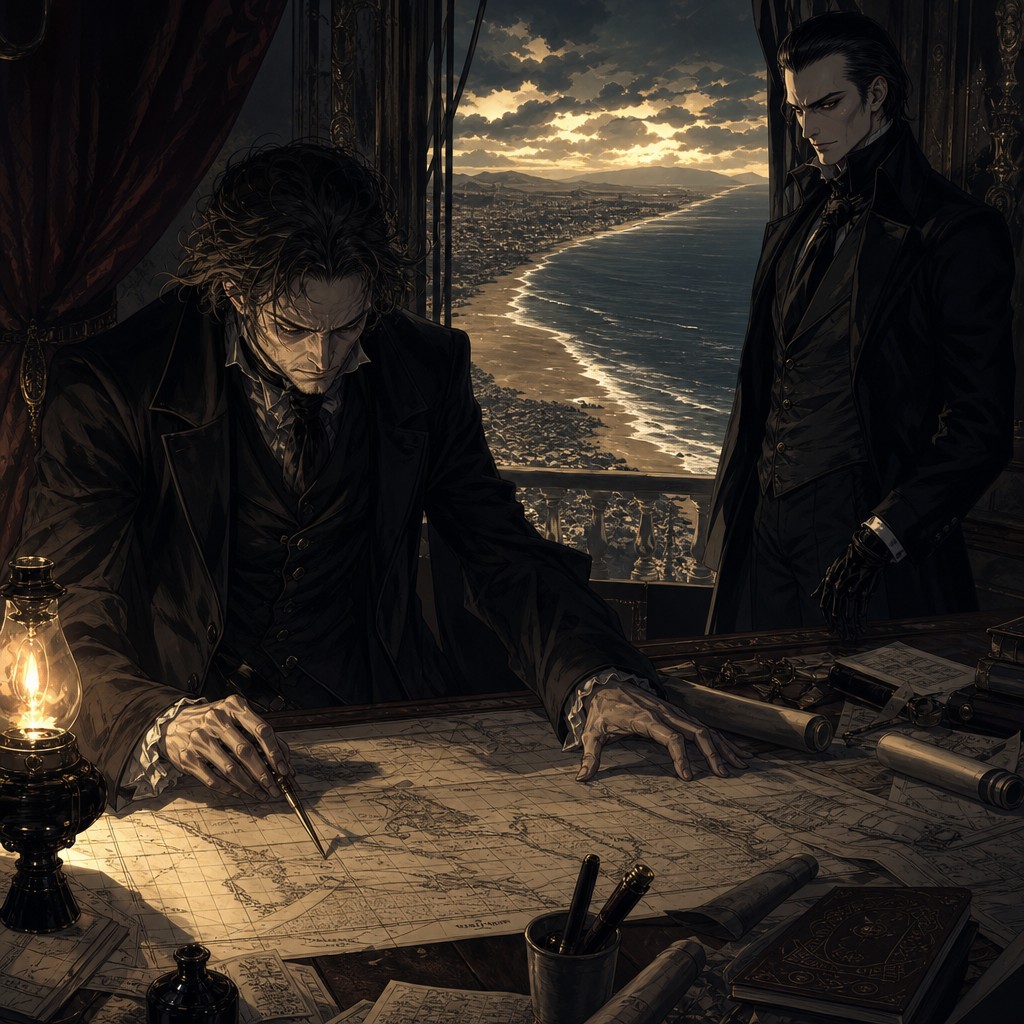
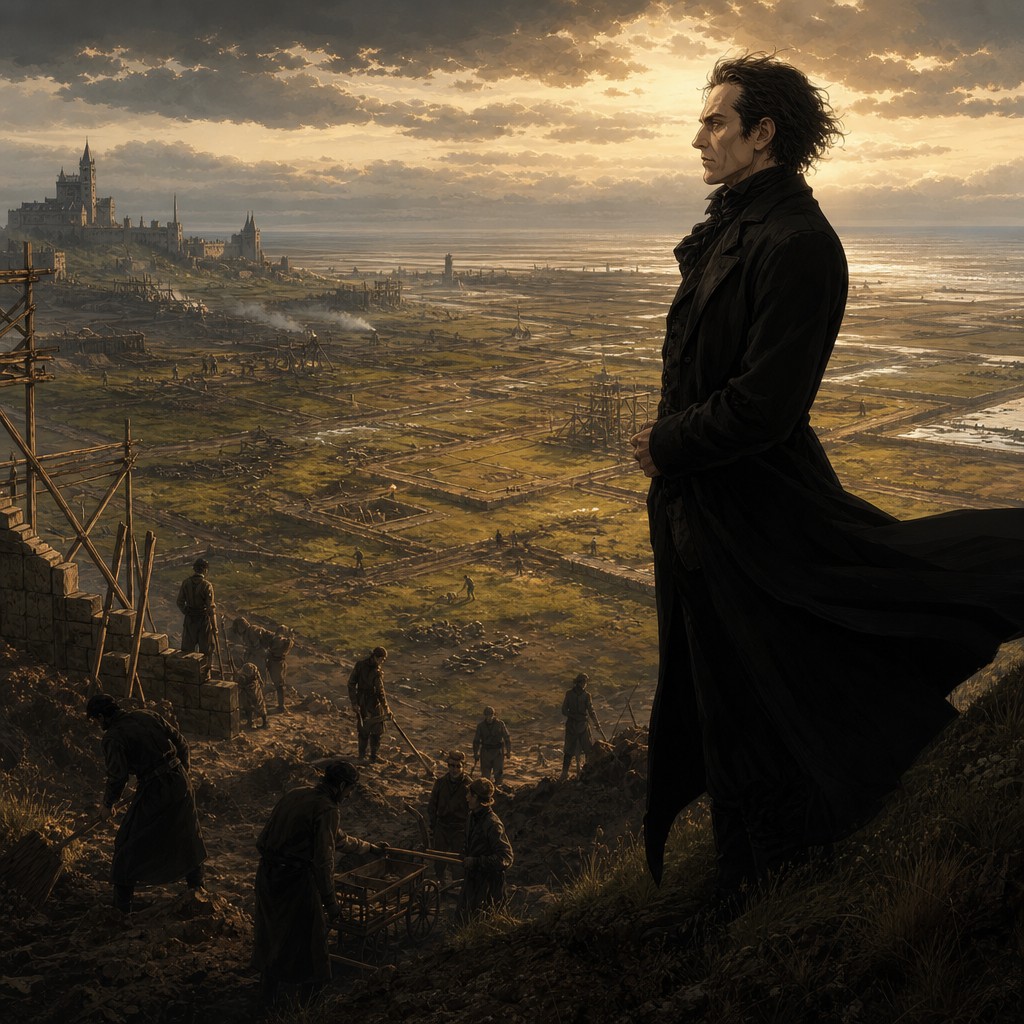
He stands upon a high embankment surveying wetlands that resist him with every virtue of wildness. The draining of the fens, the reclamation of capacious tracts of earth from water's dominion — this is his vision, now crystallized into something measurably concrete. Laborers move across the terrain like hoplites in formation. Dikes rise. Channels are cut. A canal gleams under uncertain light. What animates him now is not agriculture but something more egotistically grand: the fantasy of permanency itself, of human will imposing order upon the inchoate. He envisions fields yet unborn, farmsteads and granaries, the fatherland remade by his decree. Mephisto prowls at the periphery with barely-concealed irony. The construction becomes a narrative of civilization ascending from chaos. Yet the dust rising from the disturbed earth carries portents that Faust, in his hunger, chooses not to read. Nature does not bow so readily. The instruments of his ambition are also the instruments of others' displacement.
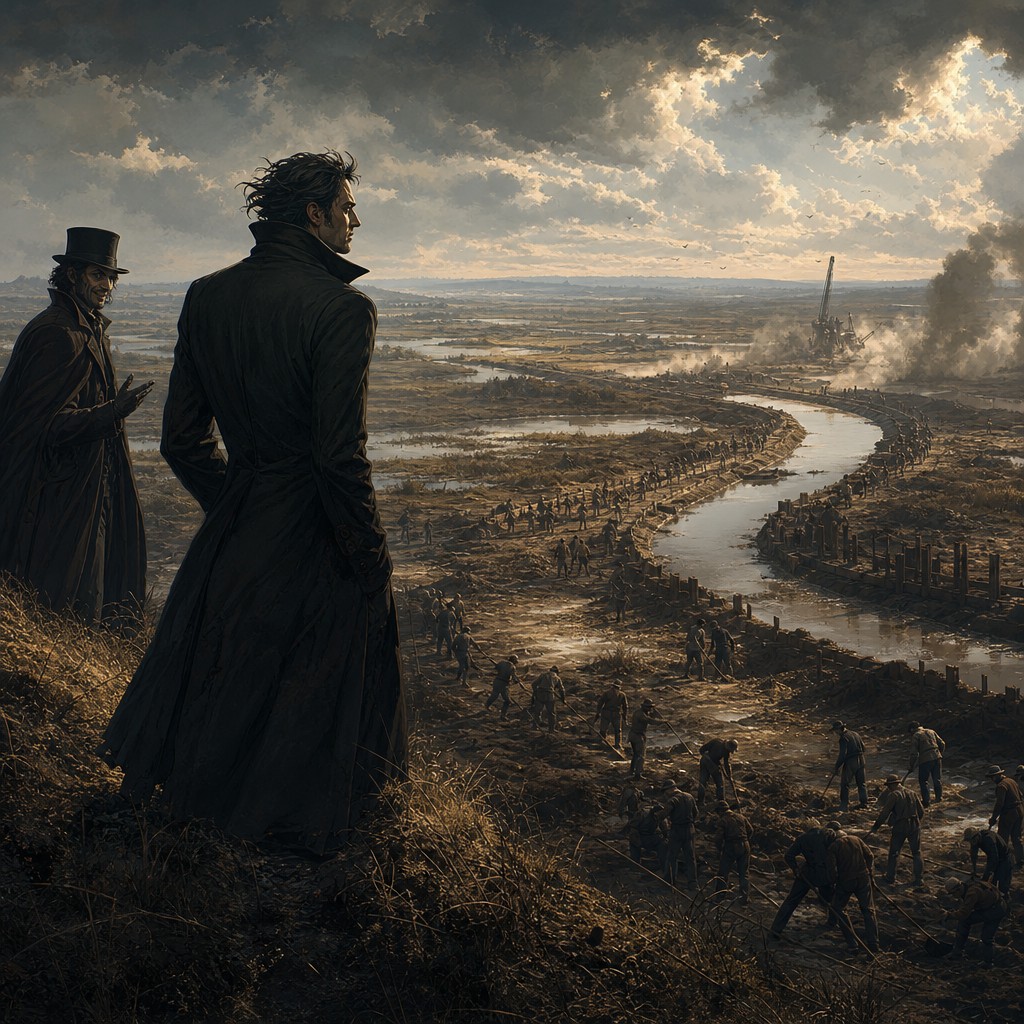
On the narrowest strip of land that remains untouched, Philemon and Baucis tend what little is theirs — a cottage hemmed by dikes and dawnlight, a garden that has held fast through decades. They do not know the name of the man whose engineers survey the marshes beyond their boundary, nor do they grasp the voracity that drives such transformation. What they know is soil, seasons, the hum of steady work. Their vow, made long ago in this very place, was not to grandeur but to the worthwhile: to plant, to shelter, to endure. Around them, the sound of construction grows louder each afternoon. They do not rebuke it. They tend their own plot with a kind of servilent grace, as though by remaining faithful to small things they might avert something larger and more terrible. In their faltering hands and the lichen-covered stones of their threshold lies a question no imperial dreamer has bothered to ask: what is lost when everything is remade?
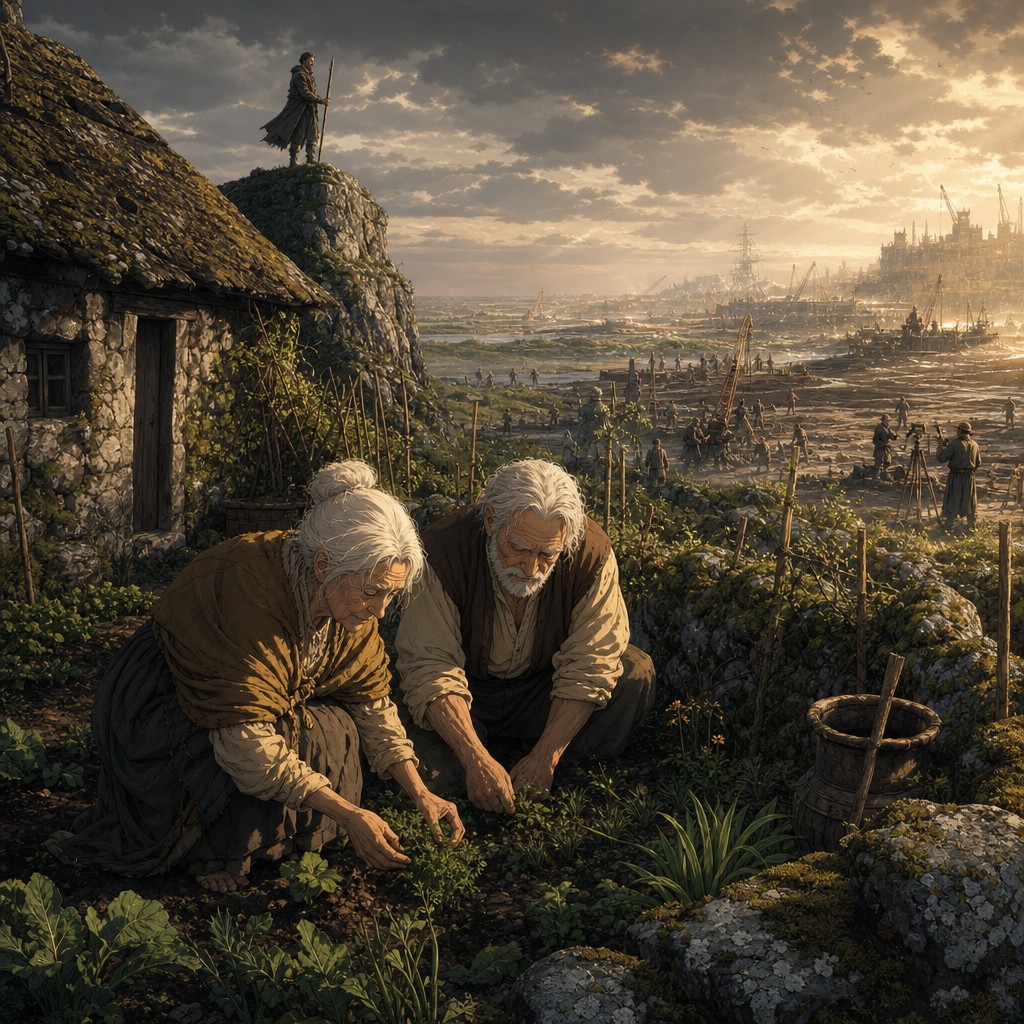
The dikes rise where marshland breathed. Faust surveys with cold satisfaction the newly expropriated fields, the vast programme of reclamation stretching toward an artificial horizon. But the cost accumulates in the soil: old tenancy swept away, communities unmoored, the moral architecture of the world bent to serve one man's hunger for dominion. Mephisto watches from the periphery, elegant and amused, as though the soot and rubble of displacement were merely the inevitable by-product of ambition — a tax paid willingly by those who dare remake the earth. Faust does not pause to consider the omission of mercy. He sees only the abundance within reach. Yet something flickers at the periphery of consciousness — a moment of surveillance, as though the universe itself regards him with contempt. The windbreak of his certainty trembles. This is the eventuality he never named when he signed: that greatness and loss are not separate ledgers. Every reclamation requires a corresponding expropriation.
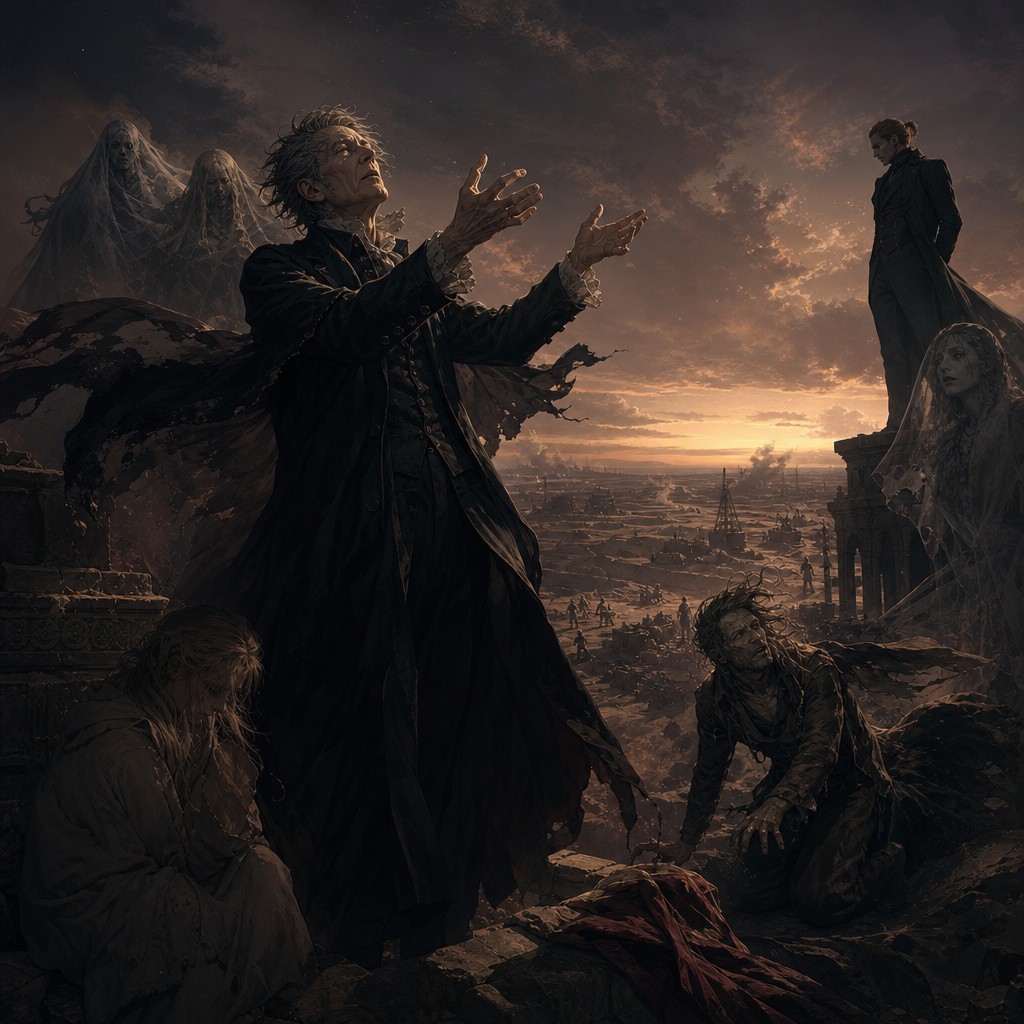
He is ninety years old, blind, and therefore finally seeing. The external world has become irrelevant, absorbed into the theoretical architecture of pure will. He speaks not to those who labor before him but to the immutability of his own vision — a vision that needs no eyes, that passes through material resistance as if through vapour. The drapery around him catches wind from lands he has drained, fields he has ordered back to life. The Gray Women drift through the edges of this scene — Care, Want, Debt, Need — spectral presences that his blindness cannot fully exclude. Care has already breathed upon him in the night, sealing his eyes. He does not know this. He gestures with audacious certainty toward a world he no longer sees but utterly commands. His blindness is not diminishment but apotheosis. In his sightlessness, Faust has become the warlock he always was — commanding by mysticism rather than sight. His blindness is his final conquest. And also his final loss.
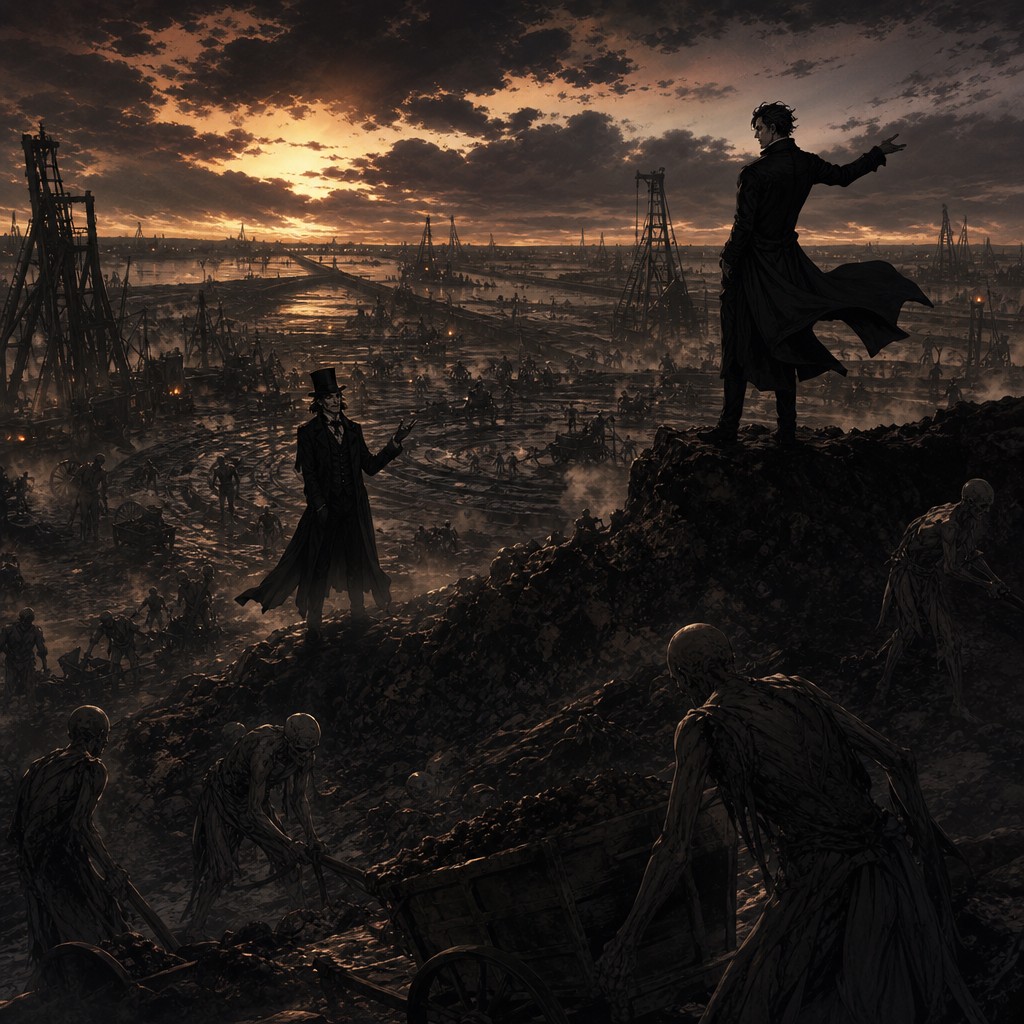
He speaks of a people free upon free ground, of daily struggle that dignifies existence — and his eyes burn with a terrible sincerity. This is the starkest moment of his striving: the instant where visionary fervor becomes indistinguishable from tyranny. Around him the landscape reforms — not by his hand alone, but by the hands of those he commands. The Lemures labor in haunting synchronization, skeletal forms hauling and dragging with obedient mute precision. The ground beneath this vision is still contested, still drenched in the blood of those displaced by his ambition. He does not see the irony: that in his hunger to build tomorrow he has mortgaged today. In this moment Faust is most himself and least human — a figure carved from his own mythology, speaking as though meaning itself bends to his utterance. The candlelight of reason has given way to the fulgurous glare of ambition. History will remember the vision. History tends to forget what the vision required.
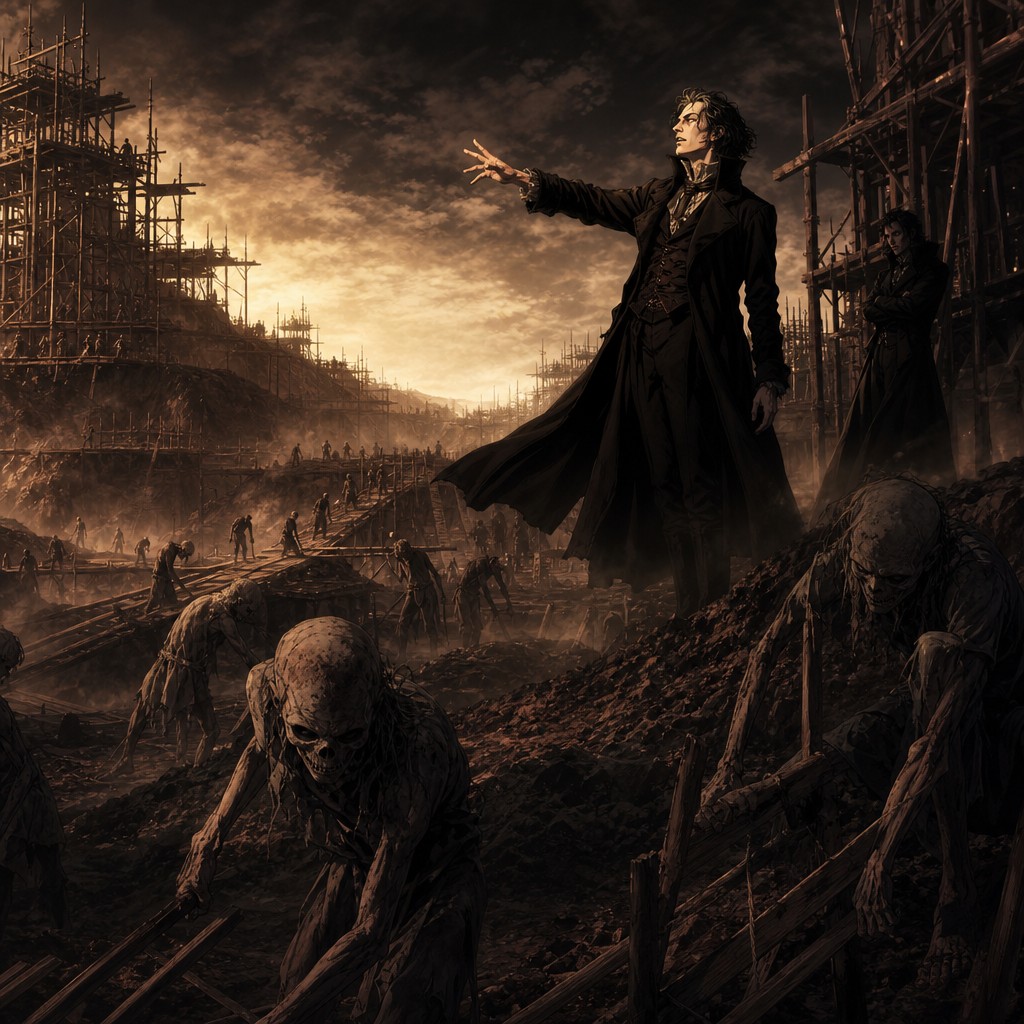
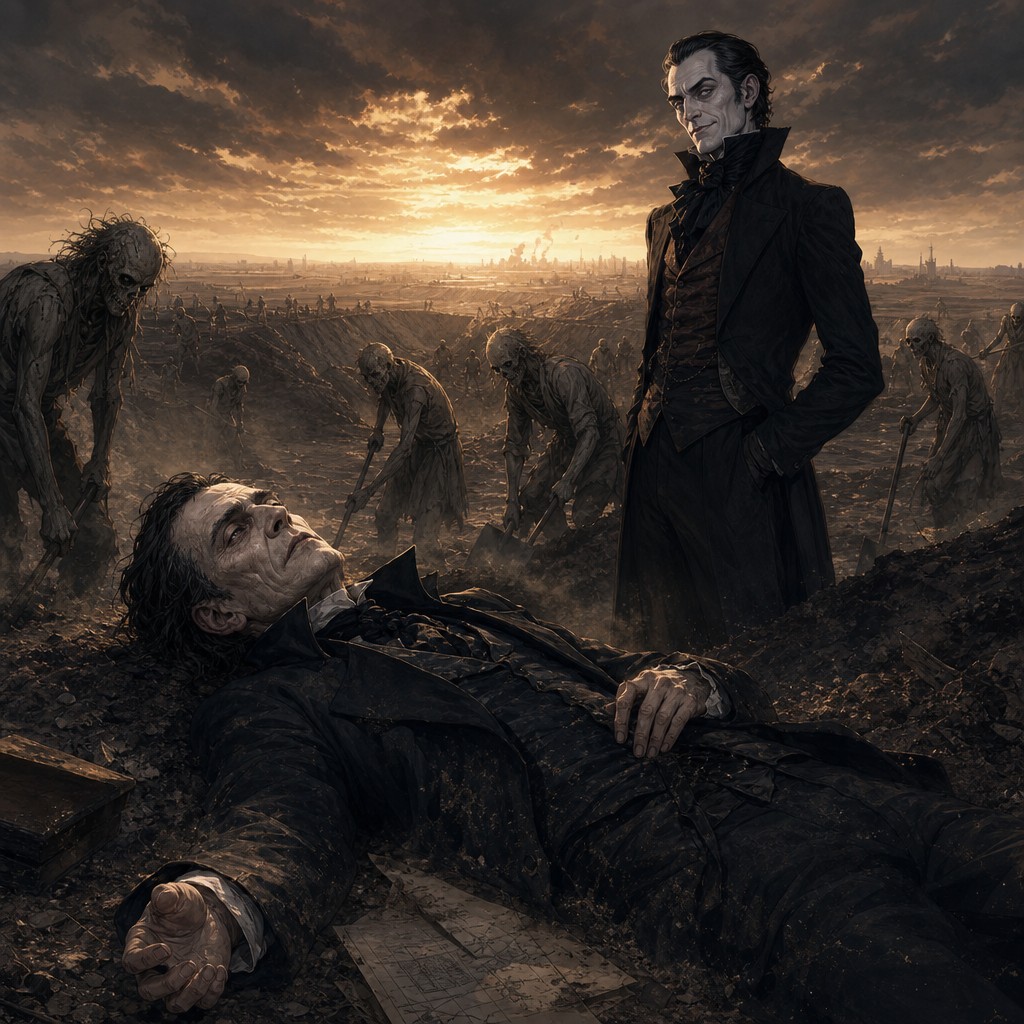
The grassy plain stretches before him, reclaimed from the sea itself — a monument written in earth and stone. Faust stands at the height of his acquisitions, surveying the empire he has built through will and contract. The labor continues. This is the moment Mephisto promised — not wealth alone, but dominion. And in the vision of completion, a terrible recognition stirs. The fever of ambition, the continual hunger that drove him through every threshold, has begun to settle into something else: contentment. Dangerous. Fatal. The striving that defined him flickers, threatens to extinguish. The pact stipulated that should such a moment arrive — should Faust ever say to the passing hour "Tarry, thou art fair" — then he belongs to darkness. He does not yet speak those words. But in the labyrinth of his own silence, they echo, waiting. The transition from hunger to possession, from reaching to holding, from fever to calm — this is the threshold no ambitious soul crosses unaltered.
The old man lies upon the threshold of his own becoming, blind yet seeing inward — the body spent, the work undone, the aim achieved in its very incompleteness. He has driven his laborers through one final day of reclamation. The whirlpool of ambition that consumed decades has narrowed to a single breath. He does not rage against the failing light. There is a strange peace in the fractional victory — the knowledge that what he began will outlive him, that his striving itself was the only goal worth reaching. Death comes not as defeat but as the final synchronization: the moment when the restless hunger ceases, and what he wrought stands witness. In his last conscious moment, Faust understands that completion was never the point — only the unconstrained reaching, the perpetual aim, the avidity that refused surcease even when the body could no longer answer. Now the body releases. The project remains. That paradox is neither damnation nor redemption, but a sibylline truth.
❦ FIN ❦